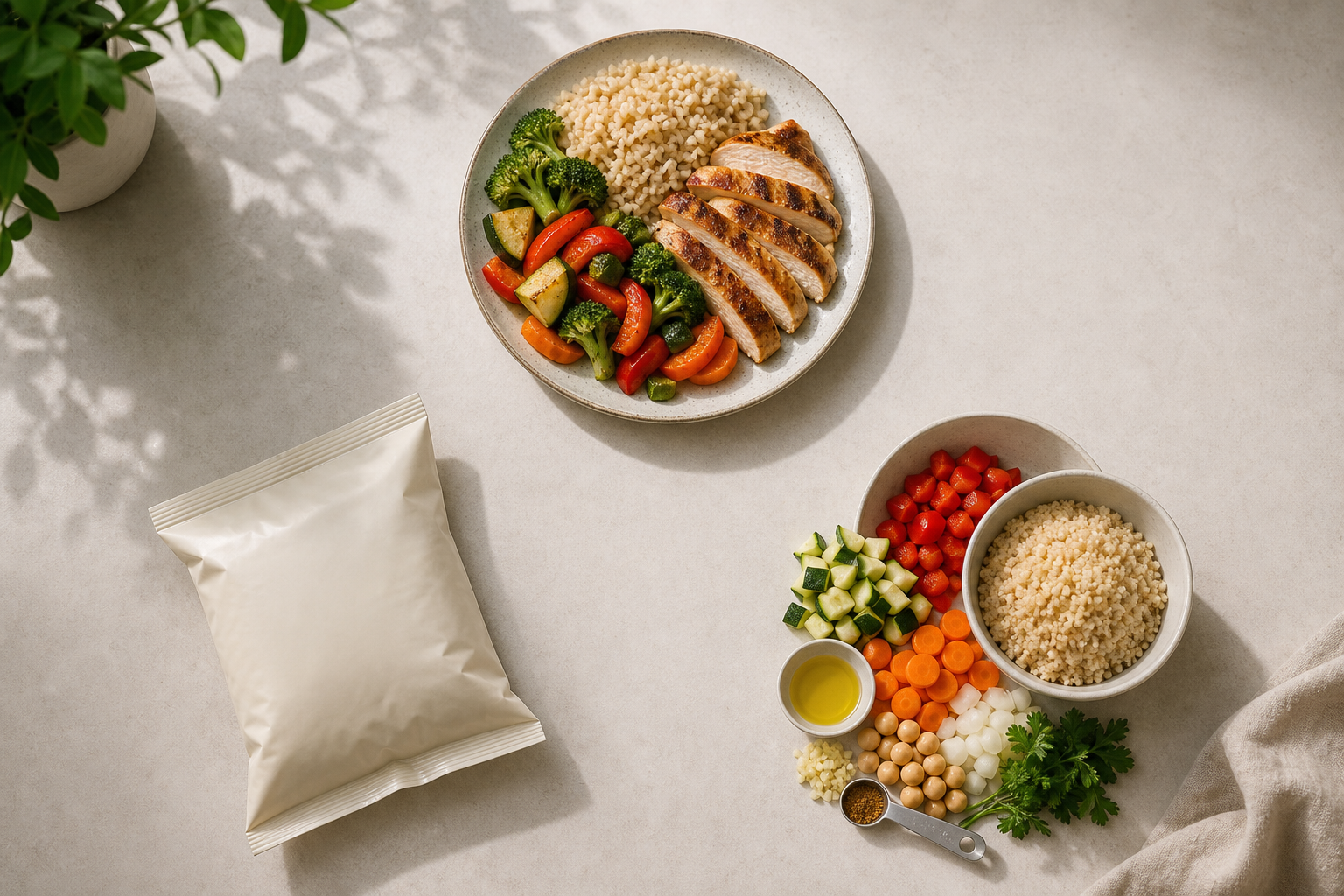
Short answer: Use meal-photo scanning when the most useful evidence is the plated meal itself: a home-cooked or mixed dish without a matching label or listed recipe. Use label scanning when you ate a packaged item and its label is available; keep the label’s serving basis and the amount you ate together. Use recipe macros when the meal is a listed recipe and you ate the stated serving with the listed ingredients. If the meal has mixed evidence, choose the path that describes the largest part most directly, or handle components separately when your process allows, and write down what remains uncertain.
The three choices answer different questions. A meal photo asks what is visible on the plate. A label asks what a named packaged product declares for its stated basis. Recipe macros describe a defined recipe and serving. They are not interchangeable shortcuts. The Eat Easier public product page describes Food Scanner as taking a photo of a meal or label, returning a calories-and-macros estimate, and letting the result be saved; it also describes a recipe catalogue of photographed single-serving recipes with macros and steps [1]. Those are product descriptions, while the selection rules in this guide are an editorial method for matching the evidence to the food you actually ate.
The core rule: match the source to the evidence
Start with the evidence you possess, not with the tool that sounds most convenient. Ask one question before logging anything:
Does this source describe the food and the amount I actually ate, or does it describe something that merely looks similar?
A photo is usually the natural starting point when the meal is a visible combination of ingredients on a plate or in a bowl. A label is the better starting point when the food is a named packaged product and the label is the clearest record available. A recipe entry is the most direct fit when the meal came from that listed recipe, the serving is known, and the ingredients were not materially changed.
This is a source-choice problem. The aim is not to make one input serve every meal; it is to avoid quietly replacing a missing detail with an assumption.
The TRACE framework
Use TRACE as a five-part check before choosing a path:
- Type of evidence — Is the evidence a plate, a package label, or a listed recipe?
- Relationship to the meal — Does it cover the whole thing, one component, or only a similar dish?
- Amount basis — What quantity, serving, or portion does the source represent? Write that down before you save anything.
- Changes — Were there swaps, added oil, dressings, toppings, fillings, or leftovers that alter the match?
- Explain the unknowns — Note what the source cannot show. A short uncertainty note is more useful than false precision.
The first two checks select the path. The last three determine whether the selected record needs a caveat or a different source. If the source and the eaten portion disagree, change the source before trying to make the record look tidy.
A quick three-way test
- Plate first: choose meal-photo scanning when the food is homemade, mixed, or assembled and no single label or matching listed recipe covers it.
- Package first: choose label scanning when the packaged item is the food being logged and you can identify the label’s serving basis and the amount consumed.
- Recipe first: choose recipe macros when you cooked a listed recipe as described and the serving you ate matches the recipe’s stated serving.
If two paths seem possible, choose the one that requires fewer unstated substitutions. A photographed bowl that happens to resemble a catalogue recipe is not automatically that recipe. A packaged snack photographed on a plate is still usually a label-led entry if the package supplies the relevant details.
Decision matrix: pick the path with the strongest match
| What you have in front of you | Best first path | Evidence to capture | Main reason to reject the other paths |
|---|---|---|---|
| A homemade or restaurant-style plate with several visible components and no matching recipe | Meal-photo scanning | Whole meal, visible components, portion clues, and any added fats or sauces | A label does not cover the whole plate; a similar recipe may import ingredients you did not eat |
| A packaged food eaten on its own or as the main item | Label scanning | Product identity, label serving basis, amount eaten, and additions | A meal photo can show the packet but not replace the product-specific information |
| A listed Eat Easier recipe cooked with its listed ingredients and eaten in the stated serving | Recipe macros | Selected recipe, serving, and any deviation from the listed ingredients | A photo adds a visual estimate when the defined recipe already matches the meal |
| A catalogue recipe with substantial swaps, extra oil, or different portions | Meal photo for the resulting plate, or a label for a packaged changed component | The changes, the visible portion, and the source for any packaged addition | The unmodified recipe no longer describes the complete meal |
| A mixed plate containing a labelled item, homemade food, and a sauce | Use the clearest source for each part when your process allows; otherwise choose the source covering most of the meal and flag the rest | Component list, package details, sauce or cooking-fat note, and portion assumptions | A single source may hide the parts that make the meal different |
The matrix is deliberately conservative. It does not ask which path produces the most attractive number. It asks which path gives the clearest account of what was eaten. When the answer is partial, the note should remain partial.
Example: one dinner, three source choices
The following examples use the same decision rule in three ordinary situations. They are illustrative scenarios, not measured tests or customer records.
Example A: a photographed home-cooked bowl
Suppose dinner is a bowl containing cooked grains, roasted vegetables, chicken, and a dressing added at the table. There is no package for the complete dish and no listed recipe that was followed exactly.
TRACE decision: The type of evidence is a plate. The relationship is direct for the visible components, but weaker for the dressing and cooking fat. The amount basis is the portion served. The changes are the dressing and any oil used during cooking. The unknowns are the quantity of those additions if they were not measured.
Choose: Meal-photo scanning. Before taking the photograph, keep the components visible and avoid covering the bowl with a lid or other object. Afterward, write a note for the dressing, cooking fat, and any ingredient that is hidden under another component. Do not select a catalogue recipe simply because its photograph looks close; the missing recipe match is the important fact here.
Example B: a packaged food with a label
Suppose lunch includes one packaged soup, but only part of the container is eaten. The package is available and its nutrition label gives a stated serving basis.
TRACE decision: The type of evidence is a label. The relationship is direct to the product, but the amount basis needs attention because the container and the label serving may not be the same unit. The change check covers bread, toppings, oil, or anything stirred in.
Choose: Label scanning. Capture the label for the product, record the label’s serving basis, and record how much of the product was eaten. Keep additions separate in your notes. If the amount is uncertain, say so rather than silently treating the whole package as one serving. A photo of the bowl can be useful context, but it is not the clearest first source when the package identifies the food.
Example C: a listed recipe cooked as written
Suppose dinner is one recipe from the Eat Easier catalogue, prepared with the listed ingredients and divided according to the listed single-serving instructions. No substitutions or extra toppings are added.
TRACE decision: The type of evidence is a listed recipe. The relationship is direct, the serving basis is defined by the recipe, and the change check is clear. There is no unresolved component that needs a separate source.
Choose: Recipe macros. Select the recipe that was actually cooked, confirm the serving you ate, and save that selected result in the Eat Easier account. You do not need to replace a matching recipe record with a meal photo merely because the finished plate could be photographed. If you later add extra oil, cheese, or a side, update the source choice or annotate the addition instead of treating the original recipe as the whole meal.
These examples show why the same person can use all three paths in one week. The choice follows the evidence for that meal, not a permanent preference for one input.
Evidence checklist before you save
Use the relevant list, then stop when the source no longer matches the food.
Meal-photo scanning checklist
- [ ] The complete plate, bowl, or serving is in view.
- [ ] Distinct components are visible rather than hidden under one another where practical.
- [ ] You have noted sauces, dressings, cooking fats, fillings, and toppings.
- [ ] You have a reasonable portion description, such as the amount served or the fraction eaten.
- [ ] You have marked any ingredient that the image cannot reveal.
- [ ] You checked whether a defined listed recipe or product label would describe the meal more directly.
Label-scanning checklist
- [ ] The label belongs to the product that was eaten.
- [ ] The label’s serving basis and the amount consumed are recorded together.
- [ ] You have distinguished the packaged food from additions or preparation ingredients.
- [ ] You have noted whether only part of the package was eaten.
- [ ] You have flagged any uncertainty about the product, serving basis, or amount.
Recipe-macros checklist
- [ ] The selected catalogue recipe is the one you actually prepared, not just a similar-looking dish.
- [ ] The serving you ate matches the recipe’s stated serving.
- [ ] Listed ingredients were used, or every meaningful deviation is noted.
- [ ] Extra oil, sauce, toppings, sides, and swaps are recorded.
- [ ] The saved entry is labelled as the recipe as prepared, not as a different meal that happens to share a name.
Implementation: a repeatable logging routine
Turn the framework into a small routine that takes less thought each time:
- Name the meal in neutral terms. Write what was eaten, not what you intended to eat. For example: packaged soup with toast and added cheese is more useful than simply writing soup.
- Mark the evidence type. Circle plate, label, recipe, or mixed. This prevents a familiar recipe from becoming the default when it was not used.
- Apply TRACE. Check the relationship, amount basis, changes, and unknowns. If one of these is missing, keep the gap visible.
- Choose the first path. Use Food Scanner for a meal or label when that is the matching evidence; use the recipe catalogue when the listed recipe and serving match what you prepared. The public Eat Easier product description supports this three-part flow and describes saving the selected Food Scanner result [1].
- Audit the selected record. Ask whether it represents the actual food or only its appearance. Look especially for hidden ingredients, a different serving, or an unrecorded addition.
- Save with a short source note. Use a compact format: source, portion basis, changes, unknowns. For example: label; half of the stated package; cheese added; sauce amount uncertain.
- Use the same rule next time. Consistency comes from repeating the evidence check, not from forcing every meal through the same input.
A reusable source card can look like this:
The card is intentionally plain. Its value is that it exposes a mismatch before the selected entry becomes the thing you remember instead of the meal itself.
When a mixed meal needs a split decision
Mixed meals are where source choice becomes most useful. Consider a homemade rice dish served with a packaged yoghurt and a spoon of sauce. There is no single source that naturally describes every part.
Use the label-led path for the packaged item if its product and amount are known. Use meal evidence for the homemade dish if its ingredients or portions are not defined by a listed recipe. Keep the sauce and cooking additions visible in the note. If your recording process only permits one primary entry, choose the source that covers the largest or least ambiguous component and label the uncovered components clearly. The purpose is not to manufacture one seamless explanation; it is to preserve the boundaries between known and uncertain parts.
This also prevents double counting by description. A recipe entry should not silently include a packaged side, and a photo of the complete plate should not be treated as proof that every hidden ingredient was identified. The source card gives each part a place without pretending that the evidence is stronger than it is.
Limitations
This framework improves source selection; it does not remove uncertainty from food records.
- A photograph has blind spots. It can document the visible meal, but it cannot by itself disclose every ingredient, cooking fat, filling, dressing, or portion detail hidden from view.
- A label has a defined scope. It belongs to a particular packaged product and is presented on a stated serving basis. It does not automatically describe other foods on the plate, or the amount you ate when that differs from the stated basis.
- Recipe macros follow the recipe. They fit the listed ingredients and serving only to the extent that your preparation follows them. Swaps, extra ingredients, different portions, and sides create a mismatch that should be noted.
- Mixed meals may need more than one evidence path. If separate recording is not practical, keep the primary source and the uncovered components explicit rather than collapsing them into an unqualified entry.
- Uncertainty is not a defect to hide. If the key portion or ingredient is unknown, the record should say what is unknown. Do not use a visually similar recipe or an assumed serving to make the note appear complete.
- Health-specific decisions need appropriate advice. If you are managing an allergy, a medical condition, medication interactions, or a clinically prescribed diet, use the relevant product information and qualified professional guidance rather than relying on this editorial selection framework alone.
No independent testing, nutritional validation, clinical review, or measured outcome is supplied for this article. The product statements above are limited to the public Eat Easier description cited in source note [1].
FAQ
Should I use meal-photo scanning for every homemade meal?
No. Use it when the plate is the clearest evidence and there is no matching defined recipe. If you followed a listed recipe and the serving and ingredients still match, recipe macros may be the cleaner source. If the homemade meal has a label-led component, keep that component tied to its label where your process allows.
I ate only part of a packaged item. Which path should I choose?
Start with label scanning because the product is identified by its label. Record the label’s serving basis and the part or amount eaten. If that amount is uncertain, preserve the uncertainty; do not silently turn the whole package into one serving.
Can I use recipe macros when I changed one ingredient?
Use them as a reference only if the change is meaningful to the meal record. For the final entry, choose a source that better describes the prepared dish or changed packaged component, and note the substitution. A recipe name alone does not make a modified meal the same recipe for logging purposes.
What if I have both a meal photo and a nutrition label?
Give the label priority for the packaged product it describes, and use the meal evidence for the rest of the plate. If you must choose one primary source, choose the source that covers more of what you ate with fewer assumptions, then list the uncovered part in the source note.
What should I write when oil or sauce is hidden?
Write that it is present but unmeasured, or describe the amount if you know it. That note is more honest and more useful for later review than selecting a recipe that omits it or assuming a standard portion.
Does saving a result confirm that the source was a perfect match?
No. Saving preserves the selected record; it does not remove a mismatch in ingredients, serving, or hidden components. Run the TRACE check before saving and keep the assumption note with the entry.
A simple default to remember
Plate with unknown or mixed ingredients: meal-photo scanning. Named packaged food with a usable label: label scanning. Listed recipe prepared and served as stated: recipe macros. Whenever the source only partly matches, keep the gap visible and choose the least assumptive path.
For more practical decision tools from the same site, browse Eat Easier Insights.
Source note
[1] Eat Easier public product page, supplied in PUBLIC_SITE_SIGNALS.json, captured 3 August 2026. It describes Food Scanner for a meal or label photo, a calories-and-macros estimate, saving the result, and a photographed single-serving recipe catalogue with macros and steps.