When one ingredient is missing, do not begin with a universal swap list. First identify what that ingredient is doing in this particular recipe: providing structure, moisture, fat, acidity, sweetness, bulk, seasoning or a finishing note. Choose something you have that can perform the same essential job, start with a conservative amount, and change the method if needed. For a single serving, keep the rest of the recipe unchanged, taste or inspect at the earliest safe point, and add more only if the dish needs it. Stop rather than improvise when the missing ingredient controls leavening, setting, allergen safety or safe cooking and you cannot establish an equivalent.
Use the ROLE framework, not an ingredient dictionary
A named ingredient can do different jobs in different dishes. Yoghurt may be the tang in a dressing, the moisture in a batter or the body of a sauce. Replacing the name without replacing the job is why otherwise plausible substitutions fail.
Use ROLE as a compact decision process:
- R — Read the ingredient in context. Note its amount, when it is added and what happens immediately afterwards. An ingredient stirred in off the heat probably has a different function from one whisked into a batter before baking.
- O — Order the outcomes. Decide what the dish must retain and what may change. Your priorities might be “binds properly, stays savoury, can lose some colour” or “keeps the sauce loose, can become less rich”.
- L — Locate the closest functional match. Compare candidates by properties, not reputation: liquid or dry, acidic or neutral, fatty or lean, strongly or mildly flavoured, cooked or ready to eat.
- E — Execute a controlled change. Change one variable, begin below the likely final amount when tasting is possible, and check texture, flavour, timing and safety before adding more.
This approach is deliberately narrow. It solves a known gap in a known recipe; it is not a way to invent an entirely different meal from miscellaneous food.
The role-first substitution matrix
Use the recipe itself to select a row. The final column is the warning that matters most in a one-serving batch, where a small absolute change can dominate the result.
| Missing ingredient’s main role | Evidence in the recipe | What to seek in a candidate | First adjustment | Main trade-off or stop signal |
|---|---|---|---|---|
| Structure or binding | Holds a patty, batter or filling together | Similar ability to set, gel or absorb | Mix a small test portion if possible; allow absorption time before adding more | Stop if the dish depends on a set you cannot predict safely |
| Leavening or lift | Creates gas or supports rise | The same type of raising action in the recipe’s chemical context | Do not assume two raising agents are interchangeable | Stop unless the recipe or product guidance verifies the change |
| Moisture | Hydrates grains, loosens sauce or prevents dryness | Similar water content and compatible flavour | Add gradually; reserve some until absorption is visible | Extra water may extend cooking or dilute seasoning |
| Fat or richness | Coats, fries, carries flavour or softens texture | Similar physical behaviour at the cooking temperature | Use only as much as the method requires, then reassess | Smoke, splitting and different mouthfeel are warning signs |
| Acidity | Brightens flavour, balances richness or reacts in a batter | A food-safe acid with compatible strength and flavour | Start diluted or below the stated amount when you can taste | Stop if the acid is required for a reaction you cannot verify |
| Sweetness or browning | Sweetens, balances or helps surface colour | Similar sweetness and, if essential, similar physical form | Reduce first; correct near the end when practical | Liquid sweeteners also change moisture and texture |
| Bulk or main body | Supplies most of the edible volume | Similar size, water content and cooking behaviour | Match the prepared volume rather than blindly matching weight | Cooking time and fullness of the serving may change |
| Seasoning or umami | Supplies salt, savoury depth or spice | Similar flavour contribution without hidden duplication | Add in small increments and taste between them | Sodium, heat and allergen profiles may differ by product |
| Garnish or aroma | Appears at the end and does not control structure | A compatible fresh, toasted or aromatic finish | Omit first; add an alternative only if it improves the dish | Often the best swap is no swap |
An ingredient may occupy two rows. If lemon juice both flavours a dressing and loosens it, your replacement must account for acidity and liquid. If an egg both binds and enriches a baked item, matching only its moisture is not enough. Treat the harder-to-replace role as the controlling one.
Example: replacing lemon juice in one chickpea couscous bowl
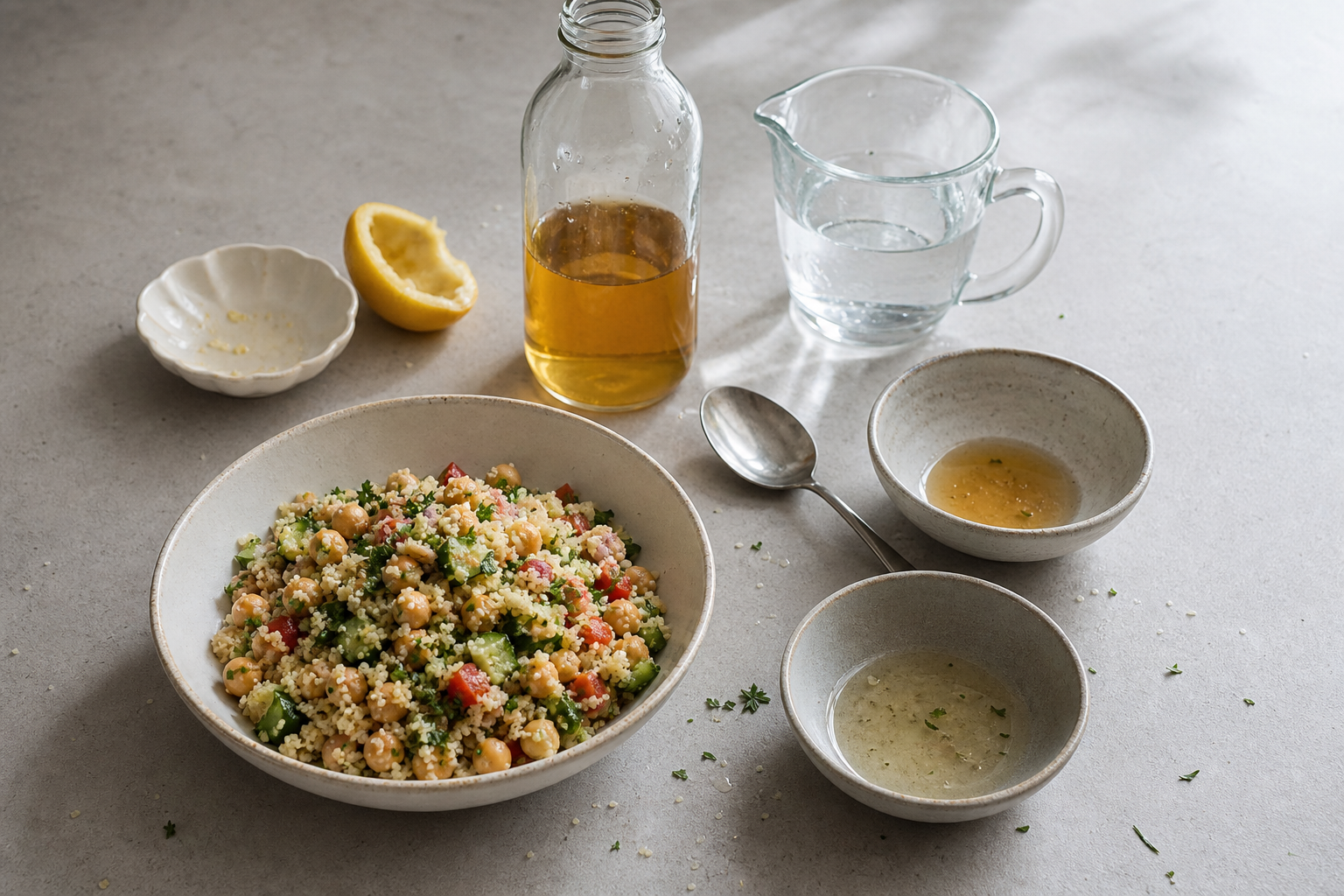
Assume a single-serving recipe uses 2 teaspoons of lemon juice, stirred into a cooked chickpea and couscous bowl after the pan comes off the heat. The lemon is missing, but mild apple cider vinegar is available. This is a worked decision, not a universal equivalence.
R — Read the context. The ingredient is added after cooking. It is not raising a batter, setting a preserve or cooking raw food. Its visible jobs are acidity, a little moisture and citrus aroma.
O — Order the outcomes. The bowl needs enough acidity to balance its savoury ingredients. The exact citrus aroma is desirable but non-essential. The serving should not become sharply vinegary or wet.
L — Locate the match. Vinegar can supply acidity and liquid, but it cannot reproduce lemon aroma and may taste more pointed. The candidate therefore covers two roles and concedes one.
E — Execute the change. Mix 1 teaspoon mild apple cider vinegar with 1 teaspoon water. Stir half of that mixture through the warm bowl, distribute it fully, then taste. Add the remainder only if the bowl still tastes flat. Do not alter the chickpeas, couscous or other seasonings at the same time.
Here is the substitution record:
| Field | Decision |
|---|---|
| Missing ingredient | 2 teaspoons lemon juice |
| Recipe role | Acidity, small amount of moisture, citrus finish |
| Candidate | Mild apple cider vinegar plus water |
| Starting quantity | Half of a mixture made from 1 teaspoon vinegar and 1 teaspoon water |
| Method or timing adjustment | Add off the heat, mix fully, taste, then decide whether to add the rest |
| Expected trade-off | Acidity without lemon aroma; potentially sharper finish |
| Doneness or safety check | No change to the original cooking and doneness instructions; use ingredients suitable for the eater and check packaged products for relevant allergens |
| Macro-estimate treatment | Recalculate only from the actual quantities and the relevant labels or chosen data source; do not retain the original lemon values by assumption |
The key is not that vinegar “equals” lemon. It is that this candidate can cover the essential roles in this specific, taste-adjustable use. The same move should not be transferred automatically to a cake, curd or preservation recipe.
Implementation steps for a one-serving swap
1. Freeze the rest of the recipe
Write down the missing ingredient and its exact stated amount. Avoid replacing several ingredients at once. A controlled substitution lets you tell whether the change worked and prevents a small recipe from drifting into an untested formula.
2. Trace what happens before and after it is added
Ask four questions:
- Is it cooked, baked or added at the end?
- Does the mixture visibly thicken, rise, bind, brown or loosen after it is added?
- Is it a large share of the serving or a small accent?
- Can you taste and adjust safely before serving, or is the decision locked in before cooking?
The answers reveal both function and reversibility. A finishing acid is easy to add in stages. A raising agent in a single baked portion is not.
3. Define one non-negotiable outcome
Write a short target such as “the patty must hold”, “the grain must hydrate” or “the dressing needs acidity”. Then list one acceptable loss, such as a different colour or missing garnish. This prevents you from rejecting a workable substitute because it is not identical.
4. Compare candidate properties
For each available option, note its form, intensity, water content, fat content, dominant flavour and cooking behaviour. Reject candidates that conflict with the eater’s allergies or restrictions. Also reject an option when its label or identity is uncertain; a clever swap is not worth an avoidable safety ambiguity.
5. Choose a starting amount, not a promised equivalence
For additions that can be tasted safely, start conservatively and reserve the rest. For bulk ingredients, compare prepared volume and expected moisture. For structure, setting or leavening, do not improvise merely because two ingredients appear together on substitution lists. Use recipe-specific or product-specific guidance, or choose another recipe.
6. Adjust the method explicitly
Record whether the substitute should be diluted, drained, chopped more finely, added later or given time to absorb. Quantity alone is rarely the whole substitution. A wetter candidate may require less additional liquid; a firmer vegetable may need an earlier start; a potent seasoning may belong near the end.
7. Check before correcting
At the earliest safe checkpoint, assess:
- Structure: does it hold, coat or thicken as required?
- Moisture: is it dry, loose or balanced?
- Flavour: is the intended role present without one note dominating?
- Timing: does the substitute still need cooking or resting?
- Safety: have the original doneness guidance and the eater’s allergen needs been preserved?
Correct one dimension at a time. If the sauce is both thin and bland, decide which issue to address first instead of adding several ingredients and losing control.
8. Revise nutrition estimates honestly
A substitution makes the original nutrition estimate provisional. Use the actual amount consumed and the label for the specific replacement when available, applying the same calculation method to both original and replacement. If quantities were added by taste or some food remained in the pan, record the estimate as approximate rather than manufacturing precision.
A reusable stop-or-swap checklist
Copy this into your notes before you cook:
- [ ] I know the missing ingredient’s stated amount.
- [ ] I can name its primary role in this recipe.
- [ ] I have checked whether it has a second role.
- [ ] I know which outcome must remain unchanged.
- [ ] My candidate matches the essential role, not just the ingredient category.
- [ ] I have checked relevant package labels and the eater’s allergens or restrictions.
- [ ] I have chosen a starting amount and kept some in reserve where adjustment is possible.
- [ ] I have written any method or timing change.
- [ ] I know the earliest safe point at which I can inspect or taste.
- [ ] I will keep the original doneness and food-safety requirements unless verified guidance says otherwise.
- [ ] I will revise any nutrition estimate using the amount actually used.
- [ ] I will stop if structure, leavening, setting, preservation or safety depends on an equivalence I cannot establish.
If you want help converting that record into one concrete option, Eat Easier publicly describes Chef Bento as providing swaps and next steps when you tell it what you have or need. Treat any suggestion as a candidate to check against the recipe, labels and the framework above—not as a guarantee.
Limitations
A role-first method narrows uncertainty; it does not prove that two ingredients are equivalent. Brands, ripeness, concentration, grind, storage and cooking equipment can change how an ingredient behaves. Taste-adjustable soups, bowls and dressings generally provide more checkpoints than baked, set or preserved foods, but each recipe still needs its own assessment.
This guide does not validate allergen-free status. Ingredients with similar culinary functions can have very different allergen profiles, and packaged foods can contain additional components. Read the relevant labels and avoid the substitution when the eater’s requirements are unclear.
It also does not supply universal ratios for leavening, curing, preserving, fermenting or setting. Those applications depend on more than flavour and volume. Use verified recipe- or product-specific instructions rather than extrapolating from the matrix.
Finally, a revised calorie or macro figure is only as sound as its inputs. The actual brand, quantity used, edible portion and leftovers all matter. When those inputs are unknown, a range or a clearly marked estimate is more honest than an exact-looking total.
FAQ
Should I replace the missing ingredient in the same quantity?
Not automatically. Equal volume may be a reasonable starting hypothesis only when the candidate has similar intensity, water content and physical behaviour. Strong acids, concentrated seasonings, wet vegetables and liquid sweeteners can change more than one part of the dish. Start below the final amount when you can taste safely, or seek recipe-specific guidance when you cannot.
What if I cannot tell what the ingredient does?
Look at its position in the method and the change that follows it. If its role remains unclear and the dish relies on baking, setting, preservation, allergen control or safe doneness, stop and use a recipe designed for what you have. For a garnish added at the end, omission may be safer and more successful than an arbitrary replacement.
Can I leave the ingredient out instead?
Yes, when it contributes only a non-essential garnish or aroma and the dish remains structurally complete. Omission is less suitable when the ingredient supplies most of the liquid, bulk, binding, lift or preservation function. Name the role first; then decide whether the dish can lose it.
How do I prevent a single serving from becoming too salty, sour or spicy?
Reserve part of the candidate, mix each addition thoroughly and taste at a safe point before adding more. Account for duplicated roles: a savoury sauce may bring both salt and liquid, while vinegar brings both acid and moisture. Do not “correct” several dimensions at once.
Do I need to recalculate calories and macros after a swap?
If you rely on those figures, yes. Replace the original ingredient entry with the specific substitute and actual quantity used. Use its package label or the same consistent data source used for the rest of the recipe, and mark the result as an estimate when the quantity eaten is uncertain.
When should I abandon the substitution?
Stop when you cannot verify a critical function, when the candidate conflicts with an allergy or dietary requirement, when safe cooking or preservation could change, or when the substitute would force several more untested changes. Choosing another single-serving recipe is a successful decision, not a failed improvisation.