Plan backwards from the ingredients most likely to be left open. Choose three different one-person dinners, put the most perishable opened item in the earliest meal, and give every purchased pack a job in the sequence. Record the amount opened, the amount each dinner uses and the amount left after dinner. If the final remainder has no named use, reduce the pack, substitute a longer-lasting option or remove it from the shop. This is a carryover plan, not three unrelated recipes.
A useful rule is: open once, reuse deliberately, and stop when the next meal would depend on an uncertain storage window. Keep the meals distinct by changing the dish structure—such as a bowl, a pasta dish and a tray meal—while reusing one or two compatible ingredients. Before cooking, follow the storage directions on the package and use your own judgement about condition; the worksheet below is a planning tool, not a food-safety guarantee.
The opened-ingredient carryover framework
1. Start with the “must-use” list
Look in the refrigerator, freezer and cupboards before choosing recipes. Mark ingredients that are already open, have a limited remaining use, or are awkward to buy in a small amount. Do not treat every ingredient as equally urgent. A sealed, shelf-stable item can usually anchor the plan; a tender opened ingredient should influence the order.
Create four columns:
| Ingredient | Amount available | Opened? | Job in the sequence |
|---|---|---|---|
| Ingredient A | Your measured amount | Yes/no | Dinner 1, 2 or 3 |
| Ingredient B | Your measured amount | Yes/no | Dinner 1, 2 or 3 |
| New item | Pack or unit size | No | Use once or carry over |
Use weights, spoonfuls or whole units consistently. A rough count is useful for deciding what to buy, but it is not a claim about how long a food remains safe.
2. Give each ingredient a role, not just a recipe
For every opened ingredient, assign one of three roles:
- Lead: the ingredient is central to a meal and should be used early.
- Bridge: a smaller amount appears in two meals, connecting the sequence without making the dinners taste alike.
- Finish: the last amount is deliberately used in dinner 3, or is not purchased.
The bridge role is where one-person planning becomes more precise. It prevents buying a large pack for a single garnish while still allowing variety. If an ingredient cannot be a lead, bridge or finish, it does not yet belong on the list.
3. Calculate carryover before choosing the order
For each ingredient, use this simple check:
Expected remainder = amount available or pack size − total amount assigned to dinners
Then classify the remainder:
- Zero or one planned portion: acceptable if dinner 3 uses it or the item is easy to store according to its label.
- More than one portion: either add another legitimate use, buy less, choose a different format, or remove it.
- An amount you cannot measure sensibly: avoid pretending the plan is exact; make that ingredient optional.
This calculation is not a serving recommendation. It simply exposes the package mismatch that causes a one-person plan to accumulate half-used items.
Example: a three-dinner carryover plan
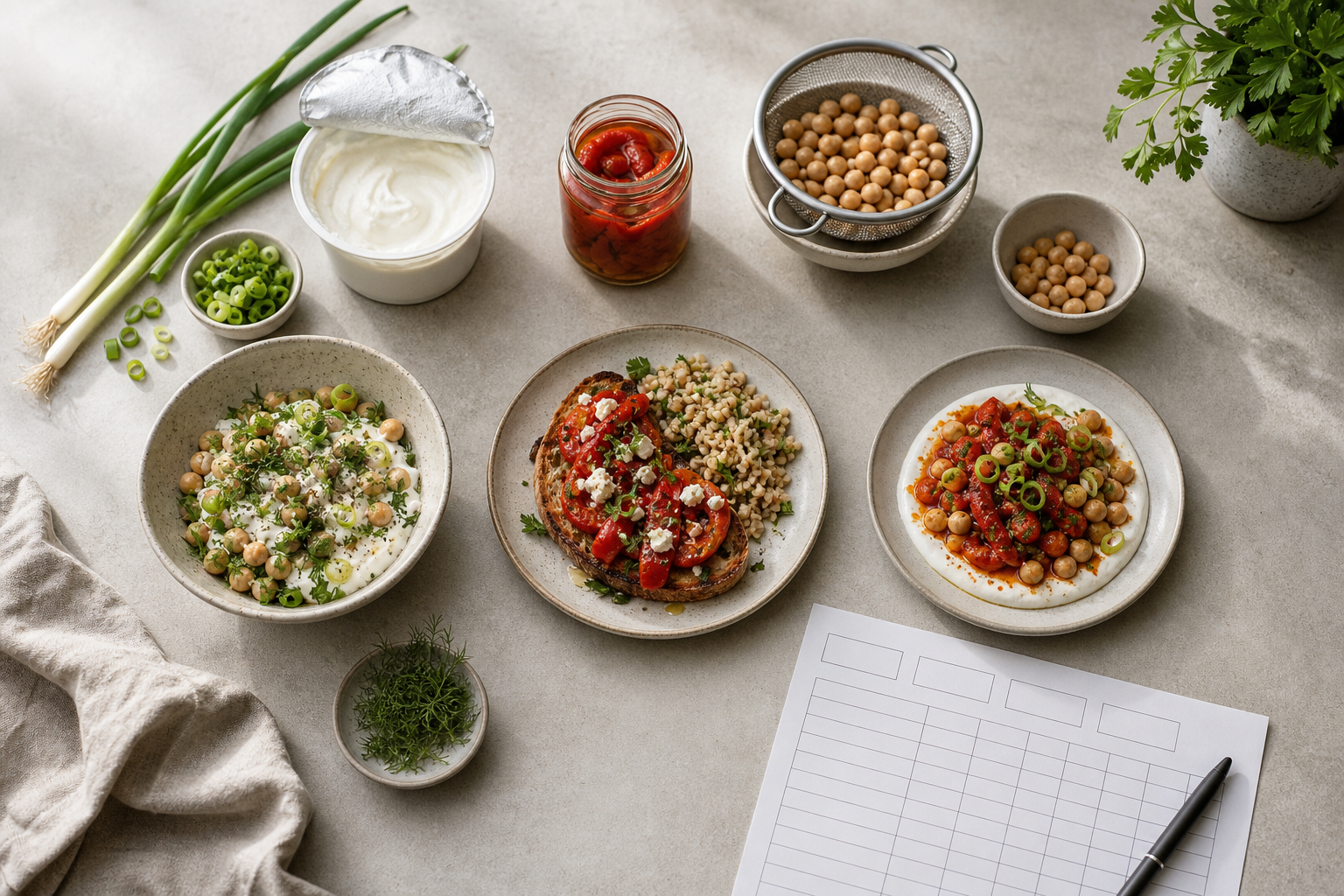
The quantities below are illustrative planning quantities, not universal portions or food-safety instructions. Imagine one person has opened a tub of plain yoghurt, a bunch of spring onions and a jar of roasted peppers. They want three dinners that do not repeat the same dish.
| Item | Available or bought | Dinner 1 | Dinner 2 | Dinner 3 | Expected remainder |
|---|---|---|---|---|---|
| Plain yoghurt | 180 g open tub | 60 g sauce | 0 g | 60 g topping | 60 g: assign to breakfast, freeze only if label permits, or do not buy/open another tub |
| Spring onions | 6 open | 2 sliced | 2 folded into filling | 2 as finishing garnish | 0 |
| Roasted peppers | 200 g jar | 80 g grain bowl | 0 g | 80 g pasta sauce | 40 g: reserve a named use or buy a smaller format |
| Chickpeas | 1 × 400 g tin | 120 g | 0 g | 120 g | 160 g: plan a lunch or use a smaller tin |
| Rice | 1 dry pack | 1 serving | 0 | 0 | Store sealed; no carryover pressure |
| Pasta | 1 dry pack | 0 | 1 serving | 0 | Store sealed; no carryover pressure |
Dinner 1 — yoghurt-pepper grain bowl. Build a bowl around the roasted peppers and a measured yoghurt sauce. Add two spring onions. The meal’s identity comes from the grain-and-topping structure, so the ingredients do not need to reappear in the same form later.
Dinner 2 — chickpea and spring-onion stuffed flatbread. Use two more spring onions and some of the chickpeas. The yoghurt is not required, and the roasted peppers can stay closed if the jar’s label and your storage plan support that choice. This deliberate pause matters: carryover does not mean forcing every ingredient into every meal.
Dinner 3 — roasted-pepper pasta with yoghurt finish. Use the second measured amount of peppers, the final spring onions and the second yoghurt amount as a cool finish if it suits the dish. Before shopping, resolve the remaining chickpeas and peppers. Add a fourth use only if it is a meal you genuinely expect to eat; otherwise change the pack size or omit the item.
The example passes for spring onions because the amount is fully allocated. It does not automatically pass for chickpeas, peppers or yoghurt: the unassigned remainder is visible, which is the point of the worksheet. A plan that admits a remainder is more useful than one that hides it in a vague “use as needed” instruction.
The carryover decision table
Use this table while drafting the sequence. Choose the first row that describes the ingredient honestly.
| Question | Yes | No |
|---|---|---|
| Is it already open and central to a meal? | Put it in the earliest suitable dinner. | Continue. |
| Can two meals use it in clearly different roles? | Mark it as a bridge and measure both uses. | Continue. |
| Does the final dinner consume the planned remainder? | Keep it and record the amount. | Continue. |
| Can you buy a smaller or single unit? | Change the shopping line before cooking. | Continue. |
| Is there a realistic fourth use you will actually eat? | Name that meal and its date in your plan. | Remove the item or choose another ingredient. |
A compact final-grocery checklist:
- [ ] Every opened ingredient has a named dinner and amount.
- [ ] Dinner 1 uses the most time-sensitive opened ingredient that fits it.
- [ ] At least one ingredient bridges meals without making them duplicates.
- [ ] The final dinner has a clear finish rather than a “leftovers” label alone.
- [ ] Pack size has been compared with the total assigned amount.
- [ ] Unassigned remainders have a real use, a storage decision or a crossed-out shopping line.
- [ ] Substitutions preserve the ingredient’s role, not merely its name.
- [ ] Package directions and condition checks remain separate from the arithmetic.
Implementation steps for a repeatable week
Step 1: Inventory in minutes, not recipes
Write down open items first. Add only the amount you can identify. Then list unopened items that need using soon according to their own packaging or your household routine. Avoid selecting recipes until this list exists; recipe-first planning tends to create a second, competing shopping list.
Step 2: Choose three meal structures
Select three forms that feel different: for example, a bowl, a pan meal and a pasta or soup. The exact cuisines are up to you. What matters is that the same ingredient can change role—sauce, filling, topping or base—rather than appearing as the same plate three times.
Step 3: Build a package-to-serving map
Copy the blank template below. Use one line per ingredient and assign quantities before adding optional extras.
| Ingredient | Available/pack amount | D1 amount + role | D2 amount + role | D3 amount + role | Remainder decision |
|---|---|---|---|---|---|
If a line cannot be completed, treat it as unresolved—not as permission to buy it automatically.
Step 4: Order by risk and effort
Put the dinner that uses the most vulnerable opened ingredient first, then the dinner that uses the strongest bridge ingredient, and finish with the meal that clears the remaining planned items. Consider cooking effort as well: a complicated dinner after a long day can cause the whole sequence to fail, leaving the ingredient unused despite a perfect calculation.
Step 5: Separate planning from storage
The worksheet tells you what you intend to use. It does not establish a shelf-life period or override a package’s instructions. Record “use by label guidance” or another conservative household reminder where needed. If you are unsure about an item’s condition or storage, do not use the carryover arithmetic to talk yourself into eating it.
Step 6: Recheck after shopping
Packages vary. Replace the planned amount with what you actually bought, then run the remainder calculation again. If the result is awkward, remove an optional ingredient or assign the remainder to a meal you have explicitly chosen. Do this before opening the pack.
For the digital execution path, you can explore Eat Easier’s recipe and planning flow—the public site describes a single-serving recipe catalogue, a Weekly Planner and smart groceries. Treat those as tools for organising the plan; the carryover decisions still need your ingredient measurements and judgement.
Limitations: when this method is not enough
This framework cannot tell you whether a particular food is safe to eat, how long it keeps, or whether a package’s contents are interchangeable. Follow the product label and appropriate food-safety guidance, and discard food when its condition is doubtful. It also cannot make an oversized package disappear: if the smallest available size is much larger than your three-dinner total, a fourth use, different format or omission is the honest answer.
The method is less suitable when your schedule changes daily, when several people share the ingredients, or when you need strict medical or allergen control. In those cases, keep the role-and-remainder calculation, but verify every ingredient and substitution against the relevant professional or package guidance. Finally, using an ingredient in several meals can save shopping effort while reducing variety if you let the bridge role dominate. Three meals should remain recognisably different and acceptable to you.
FAQ
How many dinners should I plan at once?
Three is a practical starting sequence because it gives an opened ingredient an early use, a possible bridge and a final check without requiring a long forecast. Use fewer when storage or schedule uncertainty is high. Add a fourth only when it is a real planned meal, not a placeholder for an unwanted remainder.
Should I use every opened ingredient in the next dinner?
No. Use the ingredients that are most suitable for the first meal, especially those you do not want to carry forward. A bridge ingredient can wait for a later role, and an unsuitable item should not be forced into a dish merely to make the table balance.
What if the package is larger than three one-person dinners?
Calculate the remainder before buying or opening it. Choose a smaller format where available, plan a separate meal you will actually eat, or omit the item. “Use leftovers later” is not a complete plan unless “later” names a meal and fits your schedule.
Can I substitute an ingredient to avoid opening a new pack?
Yes, if the substitute performs the same job in the dish and fits your dietary and safety requirements. Recalculate the amount and the new remainder. Do not treat a name match as proof that the cooking method, texture or suitability is the same.
How do I keep the dinners from tasting repetitive?
Reuse ingredients by role rather than by finished dish. For example, an opened vegetable can be a bowl component in one meal, a filling in another and a sauce element in a third. Change the base, texture and finishing elements, and remove the bridge ingredient if it starts dictating every dinner.
Does a meal-planning tool decide whether an opened ingredient will spoil?
No tool should replace your reading of the package, storage practice and condition check. A planner can help organise recipes, meals and grocery lines; the food-specific storage decision remains yours.