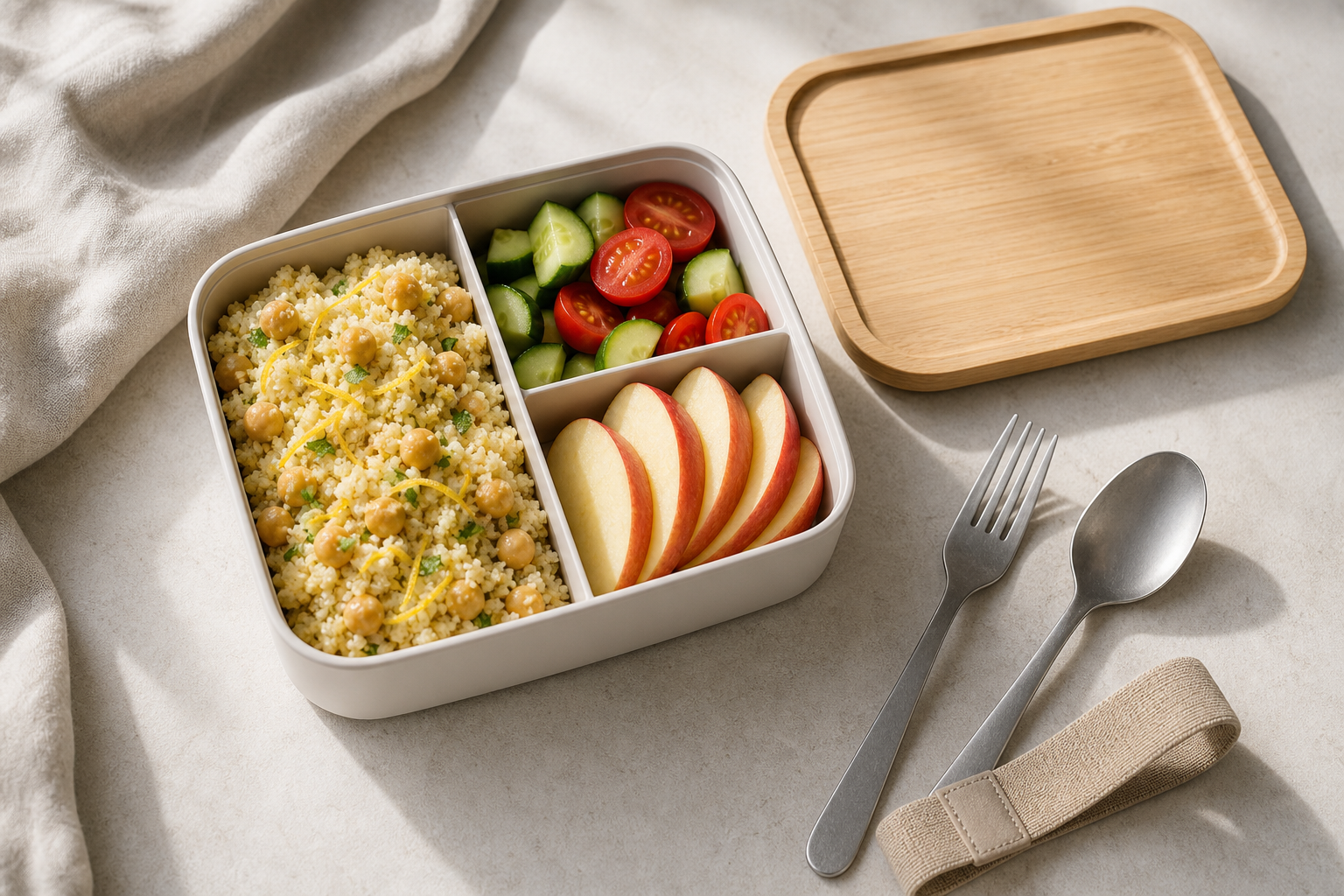
Pack one substantial main component in the first compartment, a contrasting produce-based side in the second, and a smaller finishing component in the third. Portion the food on a plate first, then transfer it to the box so the compartment sizes do not dictate an accidental lunch. Keep wet or runny elements out unless you have a suitable separate container. Finally, close the lid and confirm that the cutlery and strap are with the box. That gives you one complete lunch in the practical sense: the intended food is present, every compartment has a clear job, and you have what you need to eat it away from home.
“Complete” here does not mean nutritionally perfect, nor does it require three unrelated dishes. It means the lunch has an anchor, useful support and a finish, with no essential eating item left on the counter. The method below works with leftovers or a lunch prepared specifically for the box.
The Anchor–Support–Finish framework
A three-compartment bento is easier to pack when you assign roles before assigning space. Start with what the lunch needs to do, not with a rule that every compartment must be filled to the rim.
1. Anchor: the reason this is lunch. This is the component you would be most disappointed to forget: perhaps a grain-and-legume mixture, sliced omelette with rice, pasta with vegetables, or the substantial part of last night’s dinner. It normally takes the compartment that best fits its volume. “Anchor” describes its role, not a specific food group.
2. Support: the deliberate contrast. Choose something that makes the anchor easier or more pleasant to eat. If the anchor is soft and savoury, the support could be crisp cucumber and radish. If it is dense, the support could be fruit or simply prepared vegetables. Contrast can come from texture, temperature, acidity or flavour; it need not come from an extra recipe.
3. Finish: the small component with a purpose. The third compartment should solve a specific need: a piece of fruit, crunchy vegetables, bread, a firm garnish or another part of the meal. It is not a gap that must be filled with a token item. If the planned finish does not suit the compartment, revise the component rather than forcing it in.
Then add a fourth step outside the food map: Carry. A packed lunch is not ready merely because the food fits. The Eat Easier Bento Box is publicly presented as having three compartments, a wood lid, cutlery and a strap. Those details support a simple final check, but they do not establish leakproofness or food-storage performance.
Map the lunch before filling the box
Do a quick “plate test” before packing. Put the intended single serving on a plate or clean work surface. Look at the lunch as one meal and ask:
- Is the anchor substantial enough for the lunch I intend?
- Does the support add a useful contrast rather than duplicate the anchor?
- Does the finish have a job, or am I adding it only to occupy space?
- Is any element free-flowing, heavily dressed or likely to release liquid?
- Will I need a knife, fork or spoon to eat what I have chosen?
The plate test prevents a common packing error: filling the largest compartment first and then discovering that an important part of lunch no longer fits. It also reveals when a meal is really one cohesive mixture plus two accompaniments—which is entirely valid.
Next, match components to compartments by fit and interaction:
| Decision | Put it in the compartment when… | Change the plan when… |
|---|---|---|
| Anchor | it fits without needing the lid to press it down | closing the box would compress or displace it |
| Support | it benefits from being kept distinct from the anchor | it is so wet that it could spread beyond its intended section |
| Finish | its size and shape suit the remaining space | it is only filler or needs an unsupported storage claim |
| Carry items | the meal requires them and they can travel with the box as intended | the chosen food requires an item you have not packed |
This is a decision table, not a promise that dividers prevent transfer. Treat each compartment as an organising boundary, not as evidence of a seal.
Example: lemon chickpea couscous lunch for one
This worked example is an original one-serving packing demonstration for this guide. It is designed to show the method, not to prescribe a particular nutritional target.
Prepare the components
For the anchor, combine cooked couscous with drained chickpeas, chopped parsley, lemon zest and a small amount of olive oil. Season it to your preference. Keep the mixture cohesive rather than adding free liquid.
For the support, use sliced cucumber and halved cherry tomatoes. If you want additional lemon juice or dressing, add it when eating rather than assuming the bento can transport loose dressing.
For the finish, choose firm fruit that fits the smallest available compartment, such as apple slices. This gives the third space a clear purpose without requiring a second cooked side.
The quantities should add up to the single serving you intend to eat. Compartment dimensions and appetites vary, so fixed gram amounts would create false precision. Use the plate test first and adjust the balance before the food enters the box.
Map and pack
- Assign the compartment that best accommodates the couscous mixture as Anchor. Spoon it in without mounding it above the compartment edge.
- Assign the next suitable compartment as Support. Add the cucumber and tomatoes with no pooled dressing.
- Put the apple in the remaining compartment as Finish. Cut it only as small as needed to fit comfortably.
- Inspect the top edge. Remove or rearrange anything that would interfere with ordinary closure; do not use the lid to force down an overfilled meal.
- Fit the wood lid as intended, include the cutlery needed for the couscous, and secure the strap as intended.
The result is one coherent lunch rather than three miniature recipes. Couscous and chickpeas form the anchor, fresh vegetables provide contrast, and fruit completes the planned set. The example also passes the carry check: the box is closed and the eating utensil is present.
Implementation steps for any one-serving lunch
Step 1: Define the meal in one sentence. Write or say, “My lunch is [anchor] with [support] and [finish].” If you cannot complete the sentence without listing vague possibilities, decide before you start packing.
Step 2: Remove unsuitable transport assumptions. Set aside soup, loose sauces and heavily dressed components unless you have another container whose performance you already know. This guide makes no claim that the Bento Box is leakproof.
Step 3: Assemble one intended serving outside the box. This keeps the serving decision separate from the geometry of the container. It also lets you see whether the three roles work together.
Step 4: Rank by importance and fit. Place the anchor first, but do not automatically give it a particular location; compartment proportions can vary. Put the component with the least flexible shape where it fits, then adjust the more flexible components.
Step 5: Leave closure clearance. Keep all food below the point where it could obstruct normal closure. If something does not fit, reduce, recut or move it. Compression is not a packing strategy.
Step 6: Run the Carry check. Close the lid. Check the cutlery. Fit the strap. Add any personal non-food essentials you routinely need, such as a napkin, outside the box rather than pretending they are part of the three-compartment map.
Step 7: Make only one note for next time. Record the specific adjustment that would improve the next pack: “less couscous”, “cut fruit later”, or “choose a fork rather than a spoon”. A single observation is more reusable than redesigning the whole method after one lunch.
For a current view of the verified three-compartment box and its product path, see Eat Easier. Product and plan details can change, so check the live page rather than relying on details repeated in an article.
Final packing checklist
Use this at the counter, not after you have left:
Food map
- [ ] Anchor: the main component is packed.
- [ ] Support: a deliberate contrast is packed.
- [ ] Finish: the third component has a purpose.
- [ ] The combined food matches the one serving I intended.
- [ ] Nothing depends on an unverified leakproof or liquid-containment assumption.
- [ ] No food sits so high that the lid must compress it.
Carry check
- [ ] The wood lid is fitted as intended.
- [ ] The required cutlery is present.
- [ ] The strap is fitted as intended.
- [ ] Any separate personal essentials are ready to travel with the box.
- [ ] I have followed the food-handling requirements relevant to my ingredients, journey and destination.
A useful shorthand is: A–S–F, then L–C–S—Anchor, Support, Finish; Lid, Cutlery, Strap. It checks both the meal and the act of carrying it.
Limitations
This method organises a lunch; it does not validate the container’s technical performance. The supplied public product information supports only the physical details used here: three compartments, a wood lid, cutlery and a strap. It does not support a claim that the box is leakproof, airtight, insulated, microwave-safe, dishwasher-safe or suitable for any particular storage duration.
The guide also does not set storage times or transport temperatures. Those depend on the ingredients, preparation, journey, climate and facilities available at the destination. Follow authoritative local food-safety guidance relevant to your situation, especially for perishable foods. If you cannot maintain the conditions a food requires, choose a different lunch rather than treating compartment separation as a safety control.
“Complete lunch” is used as a practical packing definition, not a medical or nutritional assessment. Dietary needs, allergies, energy needs and therapeutic diets are individual. The framework can organise an appropriate meal, but it cannot determine what is appropriate for a particular person.
Finally, the worked example does not prove that the same component volumes fit every three-compartment container. Use the role map and plate test, then adapt amounts and shapes to the box in front of you.
Frequently asked questions
Which compartment should hold the main part of lunch?
Use whichever compartment best fits the anchor without overfilling. Do not assume the anchor must go on the left, in the largest space or in a particular shape. The role is fixed; the location is flexible.
Do I need three different recipes?
No. One cohesive main plus two simple accompaniments is enough. The value of three compartments is organisational: each component has a job. Turning every space into a separate recipe adds work without necessarily improving the lunch.
What if my meal has only two components?
Split a genuinely useful component if that improves packing—for example, keep fruit separate from crisp vegetables. Otherwise, rethink the meal before packing. Do not invent filler merely to occupy the third compartment.
Can I pack dressing or sauce in one compartment?
This guide cannot confirm that the box contains loose liquids. Add dressing when you eat, use a separate vessel you know is suitable, or choose a less fluid version. Do not infer leakproofness from the presence of compartments, a lid or a strap.
How do I avoid forgetting the fork or spoon?
Choose the utensil while the meal is still visible, then place it with the box before fitting the strap. The Carry check deliberately names cutlery after the lid so closure is not mistaken for completion.
Should I portion directly into the bento?
Not at first. Assemble the intended serving outside the box, then transfer it. Once you know how a familiar lunch maps to your particular box, direct packing may be quicker, but the plate test remains useful whenever the meal or portion changes.
Does a full box mean a complete lunch?
No. Fullness describes volume; completeness describes intent. A box can be full of disconnected extras and still omit the anchor or the utensil. Use Anchor–Support–Finish and the Carry check rather than judging by empty space alone.