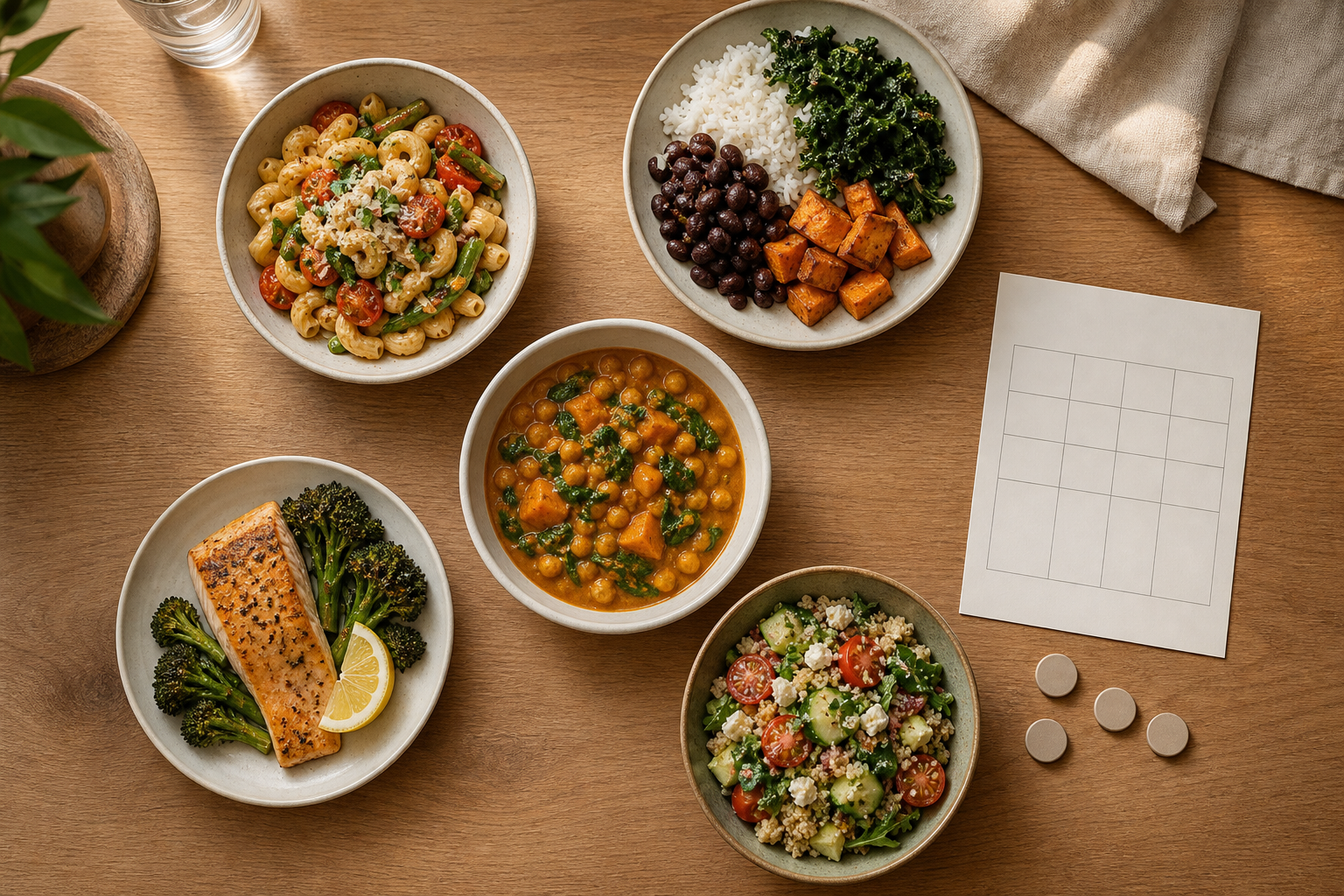
Keep a past dinner when four things are true: you would willingly eat it again, its real cooking time fits the evenings you actually have, the effort feels acceptable, and the ingredients are reasonably available. Score those four criteria from 1 to 5, then apply two gates: willingness must be at least 4, and no practical criterion should be below 3 for a core slot. From the meals that pass, choose five with different roles—quick, familiar, flexible, pantry-led or slower—and put any borderline meal in a conditional list. This separates “I enjoyed it once” from “I can happily cook it again” without making the decision from memory alone.
The Repeat-Dinner Scorecard
A dinner can be enjoyable yet still be a poor repeat candidate. Perhaps it needed an ingredient you rarely buy, took more attention than you remembered, or was satisfying only because you had an unusually calm evening. The scorecard makes those differences visible.
Score the dinner you actually cooked, not an idealised recipe. Include the real chopping, washing-up, waiting, substitutions and shopping involved. Use whole numbers from 1 to 5. A score of 5 means the criterion strongly supports repetition; 1 means it is a serious obstacle.
| Criterion | Give it a 5 when… | Give it a 1 when… |
|---|---|---|
| Willingness to eat it again | You would choose it again without persuasion. | You would rather not have it again. |
| Time fit | The actual cooking time fits an ordinary evening. | The timing regularly clashes with the time you have. |
| Effort | The active work, attention and washing-up feel manageable. | The process is too demanding for the evenings when you need it. |
| Ingredient availability | The ingredients are usually on hand or easy to include in a normal shop. | The meal depends on an item that is difficult to obtain or easy to forget. |
Add a short reason beside each number. For example, write “good taste, too much chopping” rather than entering a bare 3. The note matters because it gives you something to change later: a different version may improve effort, while a change in local shop availability may alter the ingredient score.
Apply gates before adding the points
Use the total as a sorting aid only after three checks:
- Willingness gate: a core repeat meal needs a 4 or 5. A high practical score cannot compensate for not wanting to eat the dish.
- Practical floor: for a core slot, time, effort and availability should each be at least 3. If one is lower, label the meal conditional and record the reason.
- Safety and certainty gate: if you are unsure whether the ingredients, leftovers or storage situation are suitable, leave the dinner out until you have checked the relevant label or local food-safety guidance.
For a simple starting policy, keep a meal in the core shortlist when it has a willingness score of at least 4, no practical score below 3, and a total of 15 or more out of 20. This is an editorial rule you can adjust, not a universal measure. If your week is especially tight, raise the time or effort floor. If variety matters more, keep the floor and use the tie-breakers below rather than accepting five near-identical meals.
Give each meal a role
A list of five high totals can still create a repetitive week. Assign each candidate one practical role before choosing the final set:
- Quick: the meal you can use when cooking time is short.
- Pantry-led: the meal whose core ingredients are commonly available to you.
- Low-attention: the meal that needs less active supervision, even if it takes longer overall.
- Different structure: a bowl, tray bake, pasta, soup, curry or other format that breaks up the rest of the list.
- Deliberate slower meal: a dinner worth keeping when you have time and want to cook, rather than a dish that must fit every night.
These labels describe how a meal serves your rotation, not what kind of food is objectively better. If two meals tie, prefer the one that fills a missing role. Next, favour the one with the higher willingness score, then the lower active effort, then the easier ingredient list.
Example: choosing five dinners from a small history
The meals and ratings below are illustrative inputs for the method. They are not customer records, research findings or product results. Imagine one person has six past dinners they remember well enough to score.
| Past dinner | Willingness | Time | Effort | Availability | Total | Decision and role |
|---|---|---|---|---|---|---|
| Tomato, white-bean and pasta | 5 | 4 | 4 | 5 | 18 | Keep — pantry-led |
| Ginger tofu rice bowl | 4 | 4 | 3 | 4 | 15 | Keep — quick bowl |
| Lemon chicken couscous | 5 | 4 | 3 | 4 | 16 | Keep — grain-based |
| Chickpea coconut curry | 4 | 3 | 4 | 4 | 15 | Keep — low-attention |
| Vegetable egg fried rice | 5 | 5 | 4 | 5 | 19 | Keep — fastest option |
| Salmon and potato tray bake | 4 | 3 | 3 | 2 | 12 | Hold — planned-shop meal |
The first five form the working shortlist. Notice that the decision does not simply celebrate the largest totals. The fried rice covers a very fast evening; the pasta and curry cover different ingredient and cooking patterns; the bowl and couscous add different structures. The salmon tray bake is not declared a bad dinner. It is held because its availability score is below the practical floor and its total does not meet the starting rule.
The shortlist can be written as a small rotation card:
- Fast slot: vegetable egg fried rice.
- Pantry-led slot: tomato, white-bean and pasta.
- Bowl slot: ginger tofu rice bowl.
- Grain slot: lemon chicken couscous.
- Low-attention slot: chickpea coconut curry.
If the salmon is easy to obtain next week, its availability score can be reassessed. It might replace a slot for a particular cycle, but it does not need to displace a dependable meal permanently. That is the point of a conditional list: it keeps a promising dinner visible without allowing one inconvenient requirement to dictate the whole rotation.
The keep-or-hold decision table
Use this table after scoring. The thresholds are deliberately transparent so you can change them for your own schedule instead of treating the total as a mysterious verdict.
| What the scorecard shows | Decision | Next action |
|---|---|---|
| Willingness is 1 or 2 | Do not use as a core repeat | Leave it out, or keep a note if you may want to revisit the recipe later. |
| Willingness is 3 and the total is otherwise strong | Conditional | Keep it outside the main five and ask what would make it more appealing. |
| Willingness is 4 or 5, but time, effort or availability is 1 or 2 | Conditional | Assign it to a specific type of evening, or change the version before promoting it. |
| Willingness is 4 or 5, all practical scores are at least 3, and total is 15–20 | Core candidate | Give it a role and compare it with the other candidates. |
| Two candidates meet the same rule | Use the tie-breaker | Choose the meal that fills a missing role; then compare willingness and active effort. |
| Any ingredient or leftover safety detail is uncertain | Pause | Check the relevant label or local guidance before deciding to cook it. |
Before putting a meal into the five, run this checklist:
- [ ] I am scoring the version I actually cooked, including the work around it.
- [ ] I wrote a reason for the willingness score.
- [ ] The meal has a clear role rather than occupying an accidental slot.
- [ ] Its ingredients fit the shopping conditions I have now, not an ideal week.
- [ ] I have not used a high total to hide a deal-breaking practical problem.
- [ ] I have separated core meals from conditional meals.
- [ ] No unresolved food-safety question is being treated as a planning detail.
Implementation: from past meals to the next grocery cycle
The scorecard is most useful when it changes what you do next. Use these steps to move from a remembered meal to a rotation you can act on.
1. Make a deliberately small candidate list
Start with the dinners you can describe accurately and would genuinely consider cooking again. Do not force yourself to review every meal you have ever made. A short list with reliable memories is more useful than a long archive with missing details.
For each candidate, write the name you would recognise at a glance. If two versions are materially different—such as a quick weekday version and a more involved version—treat them as separate candidates. The time and effort scores belong to the version you are likely to repeat.
2. Capture the useful facts before scoring
Record the main ingredients, the approximate cooking time, the amount of active attention, the washing-up burden and the items you had to buy. Then add one sentence about why you would or would not want it again. This prevents a pleasant memory of the finished plate from hiding an awkward process.
Do not turn this into a nutrition or recipe-audit exercise unless that is your own requirement. The question here is narrower: can this dinner earn a dependable place in your repeat set?
3. Score in two passes
First score willingness. This stops a convenient but unwanted meal from gaining momentum because it is easy to shop for. Then score time, effort and availability while thinking about a normal week. If a meal only worked because you had a free afternoon, record that in the score rather than assuming every evening will resemble it.
Use the notes to distinguish a temporary obstacle from a structural one. An unusual missing ingredient may justify a conditional label; a process that you consistently dislike may be a reason to keep the dinner out.
4. Apply the gates and make the five
Remove anything that fails the willingness gate from the core list. Put practical problems in the conditional column. From the remaining candidates, choose a set with different roles. You can use five slots for the worksheet, but you do not need to fill every slot if a smaller set fits your cooking pattern better.
A useful final check is to read the five names aloud and ask whether they represent five ways of getting dinner done, or one way repeated five times. If the latter is true, use the tie-breakers to replace a duplicate role with a meal that already qualifies.
5. Turn names into a shopping-ready list
For every selected dinner, write the ingredients needed for the version you scored. Merge repeated items, check what is already in the fridge or cupboard, and mark what needs to be bought. Keep conditional meals separate until you decide that the current cycle can support them.
If you want a connected place for this handoff, Eat Easier Club publicly describes a benefit as “Your history, ready to repeat” and says its grocery list “groups itself”. Use the scorecard to decide which dinners deserve repetition, then follow the current product interface for the history and grocery features it presents; this article does not assume a particular selector or button sequence.
6. Review the actual repeat, not the plan
After you cook one of the shortlisted dinners again, add a brief note: what made it easy, what slowed it down, and whether you wanted it when the day arrived. Change a rating only when the reason has changed. For example, a new version may lower effort, while a change in shop access may lower availability.
Keep the scorecard alive but lightweight. Revisit it when the recipe changes, your available time changes, the ingredients become harder to obtain, or you notice that a meal is being postponed repeatedly. A rotation should reflect the conditions in which you cook now.
Limitations
This method makes a personal decision more explicit; it does not make the decision objective.
- Ratings are personal and can drift. Appetite, energy, household preferences and available time can change. A 5 today is not a permanent label.
- A partial history can distort the shortlist. If an earlier dinner was never recorded or is hard to remember, the scorecard cannot recover the missing detail. Keep unknown candidates out of the core set until you can describe them clearly.
- Availability is changeable. A normally convenient ingredient may be unavailable, seasonal or inconvenient at the time you shop. Recheck the score when the shopping context changes.
- Repetition can expose a hidden weakness. A meal may look practical on paper and still become unappealing after another cook. That is a reason to lower the relevant rating, not to defend the original score.
- The scorecard is not a food-safety or medical-diet check. When storage, use-by information, allergies or other personal requirements are involved, use the relevant label and appropriate guidance before cooking.
- Product wording has a boundary. The site-specific statements used here are limited to the Club page describing history ready to repeat and a grocery list that groups itself. The article does not claim an automated choice, a particular screen, or a fixed step-by-step workflow.
FAQ
Should I keep the dinner with the highest total?
Not automatically. Apply willingness and the practical floors first. A meal with 19 points but a willingness score of 2 is not a useful core repeat for you. Among meals that pass, use totals to organise the shortlist, then choose roles so the five do not all create the same kind of evening.
How many dinners should be in the rotation?
Five is a useful size for the worksheet in this guide, not a rule. Use fewer when you prefer more repetition or have a narrow schedule. Use more when you cook often and can keep the scores and shopping details accurate. The important distinction is between core meals and conditional candidates.
What if I loved a dinner but it takes too long?
Give willingness its honest 4 or 5, then let the time score describe the trade-off. Keep the meal as a conditional or deliberate slower slot rather than pretending it is an everyday option. This preserves the memory of what you liked without making the whole rotation depend on an evening you rarely have.
Do I score the recipe or the meal I cooked?
Score the meal you would actually repeat. Include the substitutions, preparation, active attention and clean-up that came with it. If you plan to change the method, create a new candidate or write the proposed change beside the old score, then score the revised version after you know what it involves.
How can I avoid five meals that feel too similar?
Use roles as a tie-breaker. Do not select five meals solely because they have the same total. Spread the set across different cooking structures and time demands, while keeping willingness high. Variety is a selection constraint, not a reason to keep a meal you do not want to eat.
Can the app choose which past dinners I should repeat?
This article does not assume automatic selection. The public Club description names “Your history, ready to repeat” and a grocery list that “groups itself”; the scorecard supplies the personal judgement about what deserves a place in the next cycle. Check the current product experience for the exact functions available to you.
What should I do with a meal that almost qualifies?
Put it in the conditional list with one clear condition: a more suitable evening, a reliable ingredient, a simpler version or a confirmed safety detail. Revisit that condition when you build the next cycle. A conditional list is useful only if it explains what would make the meal viable.