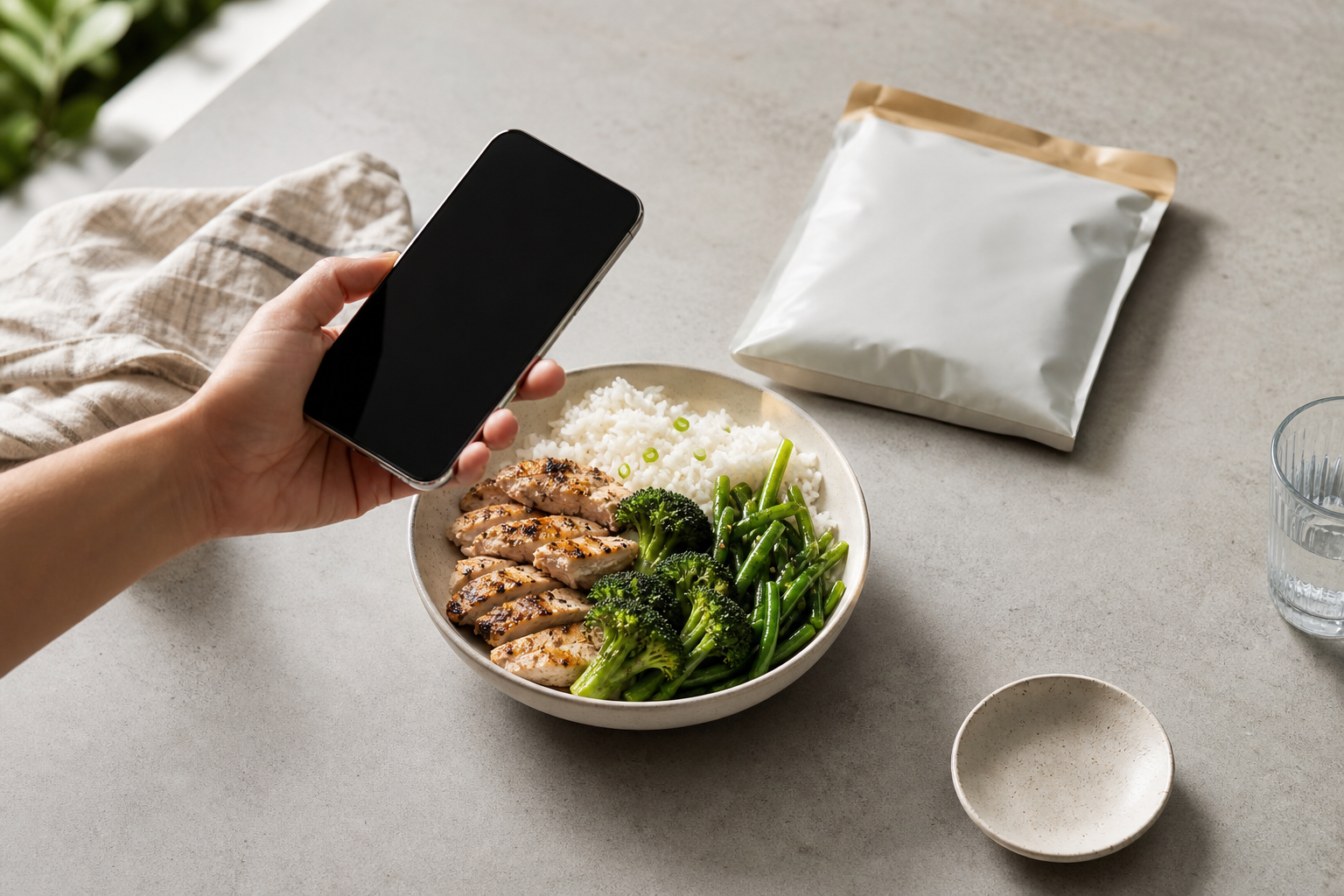
You can estimate calories and macros from a meal photo by making the portions and ingredients as visible as possible, scanning the image, and then checking the result against what you know about the meal. Treat the output as a starting estimate, not a measurement. Photograph the whole plate in even light, add ingredient or label details when available, and repeat the scan if the first image hides depth, sauces or separate components. If the result would change an important dietary decision, verify quantities rather than relying on the image alone.
The central problem is not simply whether the food can be recognised. A photograph shows appearance, but calories and macronutrients also depend on mass, recipe, cooking fat, fillings and ingredients hidden underneath other food. A disciplined workflow therefore improves the interpretability of an estimate: you can see what evidence the image provides, what remains unknown and whether another input is worth the effort.
Use the FRAME method
FRAME is a five-part method for turning a convenient scan into a decision you can explain:
- Frame the entire serving. Keep every food item and drink you want included inside the image. Avoid cropping the edge of a plate or stacking containers where their contents disappear.
- Reveal components. Separate overlapping foods enough to show their boundaries. Open a sandwich if its filling matters; place dressing beside a salad when practical; show side dishes rather than leaving them behind a bowl.
- Anchor the scale and identity. Use the full plate or bowl as visual context, and retain any reliable information you already have: package name, serving amount, recipe quantity or nutrition label. A familiar plate helps with context, but it does not turn pixels into weight.
- Make repeat captures. Take a second useful angle when depth, layers or a crowded plate could change interpretation. Compare the estimates rather than choosing the one you prefer.
- Escalate when the uncertainty matters. If an estimate affects a strict target, allergen decision or health-related instruction, move beyond the photograph. Check the recipe, package label or measured portion, or seek appropriate professional guidance.
This framework separates two questions that are often confused: “Can I obtain an estimate?” and “Is this estimate adequate for my decision?” A quick lunch log may tolerate broad uncertainty. A meal that must satisfy specific clinical advice may not.
Prepare a photo that carries useful evidence
Start with the meal as it will actually be eaten. Include condiments, toppings and caloric drinks if they belong in the entry. Use diffuse, even light so pale foods do not disappear into highlights and dark ingredients retain detail. Hold the camera steadily and keep the complete plate in focus.
A near-overhead image is useful for showing the footprint of each component. A modest angled image is useful for showing height and bowl depth. Neither angle is universally better, so use both when a meal is layered or piled. Do not add decorative ingredients solely to make recognition easier; the image should represent the serving being estimated.
Before scanning, ask:
- Can I see the boundaries between the main components?
- Is anything substantial underneath another item?
- Are oil, butter, dressing, sauce or cheese visible or otherwise known?
- Is the image showing one serving or food intended for sharing?
- Does a packaged component have a label or stated serving amount?
- Would a second angle reveal information that the first one hides?
If the answer to a question is “unknown”, preserve that as an uncertainty. Do not silently convert it into a confident ingredient or quantity.
Example: a mixed chicken-and-rice bowl
This is an illustrative workflow, not a report of a completed product test and not a nutrition calculation.
Imagine a bowl containing rice, sliced chicken, green vegetables and a glossy sauce. The overhead photo shows the ingredient types reasonably well, but it does not reveal how deep the rice is, how much sauce was used or whether oil was added during cooking. Those are material gaps even though the dish looks straightforward.
Apply FRAME as follows:
Frame: Put the complete bowl in the first image, including any sauce added at the table. Exclude unrelated dishes in the background so it is clear what belongs to this serving.
Reveal: Move a few chicken slices just enough to show whether rice continues beneath them. If the sauce is served separately, photograph it with the bowl and make its inclusion clear. Do not dismantle the meal if doing so would change the serving; record the hidden layer instead.
Anchor: If the rice came from a package and the amount used is known, retain that quantity and its label as supporting information. If the chicken and sauce were prepared from a recipe, keep the relevant ingredient amounts. A package label can inform that packaged component; it does not establish the nutrition of the entire bowl.
Make repeats: Capture one near-overhead image and one angled image in the same even light. Record each scan output exactly as shown, including calories, protein, carbohydrate and fat. Do not round one result differently to make the values appear closer.
Escalate: If the repeats are meaningfully different for the intended use, inspect the likely cause before trying more arbitrary photos. Rice depth suggests portion ambiguity; sheen without a known recipe suggests uncertainty about oil or sauce. Supply the known amount or label where the workflow permits, or log the components from reliable quantities instead. The correct outcome may be “the photo alone is insufficient”.
The example is worked without invented scan values because no original scans were supplied for this article. A real field test should publish the source images, conditions and unedited outputs together so readers can inspect what changed.
Run a three-capture repeat-scan protocol
A repeat protocol does not prove accuracy. It reveals whether the output is stable under a few plausible views of the same unchanged meal.
- Freeze the serving. Plate the meal once. Do not eat, stir, add sauce or change portions between captures.
- Record known facts. List visible components, known preparation details, package labels and measured amounts. Mark every unknown explicitly.
- Capture A: reference. Take a near-overhead image of the entire serving in even light.
- Capture B: depth. Take an angled image without moving the food. Its purpose is to expose height and container depth.
- Capture C: controlled repeat. Return to the reference angle and change only one documented condition, such as slightly brighter ambient lighting. Avoid filters, portrait blur and digital embellishment.
- Scan separately. Submit each image as a fresh scan. Copy the displayed calories and macro estimates without editing.
- Compare fields. Look at calories, protein, carbohydrate and fat individually. A similar calorie total can conceal a different macro interpretation.
- Diagnose before accepting. Connect changes to visible evidence: crop, depth, glare, overlap or an ingredient that was identified differently.
- Choose the next input. Improve the image only if visibility is the issue. Add a known label, recipe or quantity when ingredient identity or portion is the issue.
- Store the context. Keep the chosen estimate with a note about assumptions. An isolated number loses the information needed to interpret it later.
Use this blank comparison record rather than filling gaps from memory:
| Field | Capture A: overhead | Capture B: angled | Capture C: controlled repeat |
|---|---|---|---|
| Calories | Record output | Record output | Record output |
| Protein | Record output | Record output | Record output |
| Carbohydrate | Record output | Record output | Record output |
| Fat | Record output | Record output | Record output |
| Recognised components | Record output | Record output | Record output |
| Known capture difference | Reference | Angle only | One documented change |
| Important unknowns | List | List | List |
Do not average the three results automatically. An average can look precise while preserving the same hidden assumption. First decide which capture contains the clearest evidence and whether missing information can be supplied directly.
Decision table: when is the photo estimate enough?
| Situation | Main uncertainty | Best next action | Use the photo estimate? |
|---|---|---|---|
| Separate, visible components on one plate | Portion depth | Add an angled capture and compare | Reasonable for a rough personal log if repeats are coherent |
| Layered bowl, casserole or filled wrap | Hidden ingredients and amounts | Record recipe or component quantities | Only with an explicit uncertainty note |
| Restaurant meal with unknown preparation | Oil, sauces and recipe | Treat as broad; avoid false precision | Only if a broad estimate suits the decision |
| Packaged item with a readable label | Amount actually eaten | Use the label and consumed serving amount | Prefer label-based component information |
| Shared platter or multiple servings | Serving boundary | Plate one serving before the photo | Not until the serving is defined |
| Decision tied to clinical dietary advice | Several potentially material unknowns | Follow the relevant professional plan or verified quantities | Do not rely on the photo alone |
“Enough” is contextual. The purpose of this table is not to certify a scan; it is to match the quality of the evidence to the consequence of the decision.
Put the estimate into a repeatable workflow
Create a small capture routine you can use without turning every meal into an investigation:
- Plate your own serving before photographing shared food.
- Include every component that should be counted.
- Take one clear overhead image; add an angle only when it reveals something new.
- Write down material hidden ingredients you know are present.
- Preserve a package label or recipe quantity when it is more informative than appearance.
- Scan and review the identified components before focusing on the totals.
- Repeat once when framing or depth is genuinely ambiguous.
- Save the result with a short assumption note, such as “sauce amount unknown”.
Eat Easier’s public product page says its Food Scanner accepts a meal or label photo, returns a calories-and-macros estimate and lets the user save it. You can explore the Eat Easier app and Food Scanner if that workflow fits your needs. This article does not claim a level of accuracy or performance beyond that public description.
Limitations
A single image cannot directly establish food mass, recipe composition or cooking method. Visually similar dishes can contain different amounts of oil, sugar, sauce or high-fat ingredients. Bowls hide depth; toppings hide lower layers; blended foods hide almost everything about their proportions. Lighting and framing can also alter what is visible.
Repeat scans test consistency under the chosen captures, not truth. Similar outputs may repeat the same mistaken assumption, while different outputs can flag ambiguity without revealing which estimate is closer. A nutrition label is stronger evidence for the labelled product and stated serving, but it should not be treated as the ground truth for an entire mixed meal.
No original meal photographs or Food Scanner outputs were supplied with this article, so it does not report field-test results. The protocol and recording table are original editorial tools intended for a future controlled test. Calorie and macro estimates are not a substitute for medical advice, allergy controls or a professionally specified therapeutic diet.
Frequently asked questions
Can one photo estimate both calories and macros?
A photo-scanning tool can return estimates for calories and macronutrients, but the image may not contain enough evidence to resolve portions, hidden ingredients or preparation fats. Review the identified components and unknowns as well as the totals.
Should I photograph the meal from above or from the side?
Use a near-overhead image to show component area and an angled image when height, layers or bowl depth matter. The second image should add evidence, not merely provide a prettier composition.
Does putting a fork beside the plate solve portion estimation?
It may provide some visual context, but it does not reveal container depth, food density or hidden layers. Known portion quantities, recipe amounts or labelled serving information are more direct anchors when available.
What should I do if repeat scans differ?
Check what changed: crop, angle, glare, overlap or ingredient recognition. Correct the evidence problem if you can. Do not automatically select the lowest, highest or average value. If the missing information is quantity or recipe composition, provide that information or retain a broad uncertainty.
Is a nutrition-label photo better than a meal photo?
For a packaged component, a readable label plus the amount consumed can be more informative than appearance. It still describes only that product and serving basis, not unlabelled additions or the complete mixed meal.
How often should I repeat a scan?
Repeat when another capture can resolve a specific ambiguity. More images are not automatically better. Two purposeful views and one controlled repeat are more interpretable than many undocumented attempts.
Can I use the estimate for a strict diet target?
Only with caution. When a target comes from clinical advice or errors could have meaningful consequences, use the quantities and methods specified by the relevant professional rather than depending on a photograph alone.